Last updated: September 10, 2026
Key Takeaways
- Verify whether you can get a post hole at least 24 to 36 inches deep in those spots.
- Walk the line and mark the windiest ridge, the rockiest dig point, and the steepest grade with flags every 50 to 100 feet.
- The fence usually fails at the posts and the bracing, not in the middle of the line.
- For windy country, I favor materials that offer low wind resistance: wire, pipe, or open-lattice designs.
Rocky ridge. Hard wind. Sloping ground. That trio ruins weak fence fast. For ranch land like that, the best fence materials for windy, rocky, or uneven ranch land are the ones that can take movement, shed wind, and go in without fighting the terrain every 8 feet. Most owners need to think less about looks and more about post strength, span length, wire behavior, and how the fence will be braced at corners, gates, and grade changes.
I’m writing for the ranch owner who needs a working fence, not a pretty one. Basics assumed. Posts, tension, anchors — you know the drill. And I’m also assuming you want the right material before you pour money into the wrong setup for fence materials for windy, rocky, or uneven ranch land.
What actually makes ranch fencing fail on bad terrain?

The fence usually fails at the posts and the bracing, not in the middle of the line. Wind hits it like a sail. Rock makes deep posts a hassle. Uneven ground twists the frame until it racks out of square. “Racking” just means the fence starts to lean or distort because the line is forced to follow a slope or a soil shift instead of staying plumb and straight.
For windy country, I favor materials that offer low wind resistance: wire, pipe, or open-lattice designs. Solid privacy panels are the wrong tool on exposed ranch land; they catch wind, stress end posts, and can rip loose in a storm. On rocky ground, the real headache is not only the hole — it is getting enough depth and stability for the posts. So post material and diameter matter just as much as whatever you stretch between them.
On rough or rolling ranch land, the “best” fence is often a flexible setup that can step up or down grades rather than forcing one rigid line. A stepped fence uses level sections that jump in height from one bay to the next. A sloped fence follows the grade continuously. Stepped is usually simpler with wire and pipe; sloped looks cleaner, but keeping tension can get ugly when the terrain changes quickly.
My rule is blunt: if the land moves, the fence should be able to move a little without failing. That points toward woven wire, high-tensile wire, pipe, or a hybrid with strong braces and a low-wind profile. It points away from rigid panels and toward systems that tolerate some flex on fence materials for windy, rocky, or uneven ranch land. Simple. But not easy.
Which fence materials hold up best on windy, rocky, or uneven land?
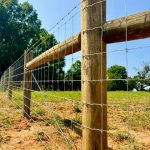
High-tensile wire is often the strongest all-around answer for exposed ranch land, though it is not the easiest to install and it is not the best choice if you want absolute visibility for livestock handling. “High-tensile” means wire built to be stretched tight under significant tension, which lets you use fewer posts and longer spans than softer wire. It does well on wind-prone ground because the fence gives the wind very little to push against. The USDA NRCS notes that high-tensile wire systems can reduce maintenance when they are properly installed and braced, but they still need correct tension and corner support. USDA NRCS
I would pick high-tensile wire for long perimeter runs, big pasture divisions, and places where the land is too irregular for a neat board fence. Its drawback is plain enough: it needs good bracing, careful tensioning, and regular checks at insulators, joints, and corners. It is the wrong fit if you want a fence that is easy to see from every angle or if your livestock regularly lean, rub, or push hard at one spot. That math stops working fast.
Woven wire is the safer bet where containment matters more than speed. It has more body than plain wire, so it handles smaller livestock better and resists a sagging middle section over uneven ground. Rocky land can make that stiffness a nuisance, though, because the fence wants a stable line and the terrain may not cooperate. Woven wire also costs more in material and labor than plain wire. For reference, fencing supply guides commonly place woven wire below pipe fence in material cost but above plain high-tensile wire, especially once labor is included.
Pipe fence belongs in a different bucket: it is excellent around gates, lanes, corrals, and corners where wind load and animal pressure stack up. Steel pipe handles abuse well and does not rely on the same tension behavior as wire. The trade-off is cost, fabrication, and installation time. I would not choose full pipe fencing for miles of boundary on rough land unless appearance and durability matter more than budget. For fencing around handling areas, the University of Wyoming Extension recommends steel pipe where impact and pressure are concentrated. University of Wyoming Extension
Wood board fencing has a place, just not usually on the windiest or rockiest ranch ground. Boards are heavy, catch wind, and need better footing than many ranch sites can offer. They can work for a short frontage, a horse run, or a handled area near buildings. They are a poor match for exposed ridgelines and broken, rocky slopes. Honestly, they look tidy — and then the wind starts talking.
Chain-link deserves caution on ranch land unless you have a specific containment need near a barn or yard. It resists wind fairly well because it is open, but it is expensive for long distances and awkward on steep or rocky terrain. It also does not belong on most grazing fences.
How do you choose the right material for your land?
Start with the failure you are trying to prevent. Then match the material to the terrain. Buying a fence because it looks durable and only later learning it cannot be anchored on your ground? Bad order.
- Map the worst 2 to 3 spots first. Walk the line and mark the windiest ridge, the rockiest dig point, and the steepest grade with flags every 50 to 100 feet. Verify whether you can get a post hole at least 24 to 36 inches deep in those spots. If not, a traditional wood-post system may fail there unless you use driven steel posts, larger augered holes, or concrete only where needed.
- Choose the fence family before the finish. For long exposed runs, pick high-tensile wire or woven wire; for gates, corners, and handling alleys, pick pipe; for short protected sections, board fence can work. Verify that the material fits the livestock class and the wind exposure. If the land is open and the fence line is long, full-board construction is usually the problem, not the solution. The University of Minnesota Extension notes that site conditions and animal pressure should guide fence type before appearance does. University of Minnesota Extension
- Set the post strategy. On rocky or uneven ground, plan corner and brace assemblies first, then line posts. In many ranch layouts, line posts can be spaced around 12 to 16 feet for wire systems, while heavy wind or livestock pressure may justify closer spacing. Verify that every change in direction, gate end, and slope break has a true brace, not just a stronger line post. A problem sign is any corner that depends on a single post alone.
- Pick a post material that can survive the soil you actually have. Steel T-posts work for many wire systems, but they are not enough for corners or gates. Round wood posts can work if they can be driven or set deep enough. Steel pipe is the better choice where rocks prevent deep augering; if you are unsure about soil, frost, or local code, consult a fencing professional before you decide. Verify corrosion resistance and wall thickness if you are using pipe; thin pipe dents and bends under livestock pressure.
- Match wire or panel spacing to terrain and animal pressure. For cattle, wider spacing can work in a well-braced high-tensile system; for goats, sheep, or calves, smaller openings or a lower bottom gap matter more. Verify the bottom edge stays close enough to the ground to discourage crawling under, especially on uneven slopes where gaps change with grade. A visible dip under the bottom line is a warning sign.
- Plan the brace for wind, not just weight. A good brace has an end post, brace post, horizontal member, and diagonal tension member. Verify the brace resists pull without leaning after tension is applied. If the brace moves when you tighten the line, the fence will move too. On exposed ridges, underbuilt braces are the first weak point.
- Decide where flexibility is useful. Put a little give in long runs with wire, and keep rigid materials to short, controlled spans. Verify that the fence can expand and contract with temperature changes without buckling or snapping fasteners. If you see bowed boards, slack wire in one bay, or posts pulled out of plumb, the system is too rigid for the site.
- Use the terrain instead of fighting it. Step the fence on abrupt slopes, and follow the grade on gentler ones. Verify that the top line stays functional even if it is not perfectly level. If you are trying to force a perfectly straight visual line across broken ground, you are often paying extra to create stress.
My preference is clear: for most windy, rocky, uneven ranch land, high-tensile wire with strong bracing wins on cost, wind resistance, and adaptability. Woven wire comes next if containment is tighter. Pipe belongs where abuse is concentrated. Full wood board is the least forgiving choice on exposed ground.
What should I avoid on exposed ranch land?
Avoid solid-panel fencing, light-duty decorative fencing, and any system that depends on shallow posts staying put in loose or fractured soil. Those materials may look finished on a flat suburban lot, but on a ranch ridge they turn into liabilities.
Wind load is the main problem with solid panels. A 6-foot solid panel can act like a sheet against the wind, loading every post in the run. The result is leaning posts, loosened fasteners, and broken rails after a storm. The better alternative is open fencing: wire, pipe rails with open spacing, or a hybrid that keeps wind moving through the line.
Underbraced corners are another thing I would avoid. A corner that saves one brace rail or one diagonal support often becomes the first thing that moves. Once the corner shifts, the whole fence loses tension. The correct alternative is to overbuild the ends and corners before you worry about the middle of the line. Period.
On rocky land, I would not assume every post can be set the same way. Some holes will refuse an auger; some stakes will hit ledge a foot down. Forcing the same depth everywhere can leave shallow posts in the worst places. Better alternatives include driven steel posts, narrow rock augers, or moving the fence line a few feet to better ground.
Cheap softwood posts are risky in wet or highly alkaline soils. In many ranch settings, they rot or crack before the fence has paid for itself. The safer alternative is pressure-treated posts rated for ground contact, steel pipe where abuse is likely, or a mix of materials that puts the expensive posts only where they are needed; if conditions are uncertain, consult a local fencing contractor or extension agent and verify the product rating before buying. The American Wood Protection Association publishes use-category guidance for preservative-treated wood in ground-contact applications. American Wood Protection Association
When should I stop and choose a different fence type?
Stop and change course when the land is asking the fence to do a job it cannot do without constant repair.
Long ridgeline exposure with no natural windbreak: the fence will take repeated wind loading — switch to open wire or pipe and avoid solid boards.
Soil that will not hold a 24-inch-plus post depth: the line will loosen fast — move the fence line, use driven steel, or change to a lighter, better-braced system.
Repeated frost heave or wet-fine soil movement: posts will work loose seasonally — use deeper set posts, better drainage, or a material that tolerates reset work, such as steel and wire rather than heavy rigid panels.
Heavy pressure from cattle rubbing, horses leaning, or livestock charging a corner: the middle of the fence is not the issue — upgrade the corners and handling sections to pipe or stronger wire spacing, not just thicker line materials.
Very steep or broken slopes with abrupt grade changes: a rigid, visually perfect fence will rack and twist — switch to stepped wire construction or accept a hybrid layout with pipe on critical sections.
Frequent rock ledge at corner locations: your brace cannot be set correctly — move corners until you find depth or use surface-mounted pipe anchors designed for the site.
In each of these cases, ignoring the warning means paying for the same repair in a new form. A different fence type is often cheaper than rebuilding the same failure three times.
The mistakes that cost ranch owners the most
The most expensive mistake is choosing by appearance instead of structure. A clean-looking board fence can be the weakest thing on an exposed ridge. Then it leans, boards go missing, and you keep straightening it. The alternative is to choose by wind load and footing first.
Another common error is spacing line posts too far apart because the material “should” handle it. The result is sag, especially on uneven ground where the center of the span changes height. The correct alternative is to shorten spacing where the line changes grade or where the soil is weak, even if the rest of the fence can go wider.
A third mistake is treating all corners the same. A corner on flat, sheltered ground is not the same as a corner on a rocky shoulder with crosswind. If the brace is underbuilt, tension migrates into the posts. If you are unsure how much brace is enough for your terrain, consult a fencing professional or local extension office before you build. The right move is to oversize end assemblies on exposed sections, even if that means more pipe or more lumber.
A fourth mistake is ignoring the bottom gap on slopes. If the fence floats too high above the ground, animals exploit it; if it drags too much, the line catches on rocks and humps. The better alternative is to step or follow the grade deliberately and check the lowest 2 feet of the line at several points before you commit to the layout.
A fifth mistake is using only one material where a mixed system would work better. Full pipe everywhere is expensive; full wood everywhere may be fragile; full wire everywhere may not be enough near gates. The correct alternative is a hybrid: pipe at corners and handling zones, high-tensile or woven wire in long runs, and wood only where it earns its keep.
How do I know the fence will work once it’s up?
You know it will work when the line stays straight under tension, the corners do not walk, and the fence conforms to the land without opening gaps at the ground. That is the real test, not whether it looked square on day one.
A good result on windy, rocky, or uneven ranch land has four signs. First, the brace assemblies stay fixed after the wire is tightened. Second, the line posts remain plumb or close to it despite grade changes. Third, the bottom edge does not leave animal-sized openings at dips or humps. Fourth, the material choice matches the job: open and flexible for exposed runs, rigid and heavy for high-pressure points, and mixed systems where the terrain changes too often for a single approach.