Last updated: September 10, 2026
Key Takeaways
- Cattle panel wins on physical restraint.
- Some cattle read a panel as a wall and stop.
- The long answer is that cattle panel is a containment tool, while barbed wire is a perimeter tool.
- If I had to pick one overall for containment quality alone, I’d pick cattle panel.
Quick Answer: for cattle panel vs barbed wire containment, cattle panel is usually the better containment choice, especially in pens, gates, and short runs. A standard cattle panel is about 16 feet long and 50 inches high, while barbed wire is commonly installed in four or five strands. Over long acreage, barbed wire costs less per linear foot, but cattle panel is tougher anywhere animals press, rub, or crowd.
For most small-to-medium containment jobs, cattle panel comes out ahead because it blocks contact, resists climbing, and gives you a safer barrier you can actually trust around people, calves, dogs, and equipment. Barbed wire still has a place when you need to fence long acreage at lower material weight and you are containing mature cattle on a budget, but it is the weaker answer anywhere an animal can push, rub, or tangle. Simple, really.
I write about fencing because the decision is never just “cheap or expensive.” Animal behavior, maintenance, gate layout, and risk all sit in the mix. A fence that holds cattle is not the same thing as a fence that protects a kid, a horse, or a dog.
Comparing these two for a new fence? The question is not which one is universally “best.” It is which one fails less badly for your land, livestock, and tolerance for repairs. In cattle panel vs barbed wire containment, the right call depends on where pressure is highest.
The real difference between cattle panel and barbed wire
Cattle panel wins on physical restraint. Barbed wire wins on coverage per dollar and on spanning distance with fewer posts. That is the trade-off, and it explains almost every good and bad outcome people report.
Usually, a standard cattle panel is a welded wire sheet, about 16 feet long and 50 inches high, made from heavy galvanized wire with small rectangular openings that tighten near the bottom. It acts like a fixed barrier. Once an animal meets it, there is nowhere for it to “give” except the panel and the posts holding it. Hard stop.
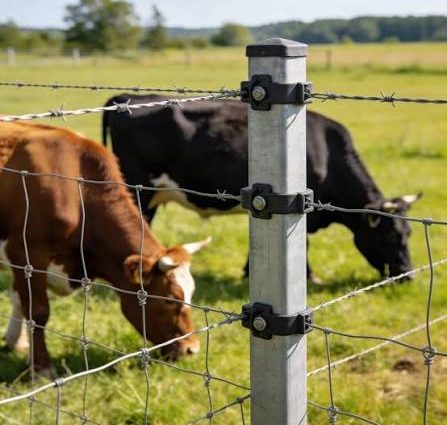
Barbed wire is a tension fence. It works by spacing several horizontal wires, commonly four or five strands in livestock applications, and using posts to keep them separated and taut. Because it uses less material per linear foot and stretches across long runs more easily, it depends heavily on post spacing, wire tension, and animal respect for the fence line. The USDA notes that fence performance depends heavily on installation and maintenance, not just wire type.
That difference matters in a real pasture. If your animals lean, scratch, test, or crowd the boundary, cattle panel gives you a wider margin for error. If your boundary is a quarter-mile perimeter and you need to fence the whole thing, barbed wire is the more realistic tool. A quarter-mile is 1,320 feet, so the savings pile up fast.
Generic articles get one thing wrong: they act as if both are just “fencing.” They are not the same containment strategy. One is a barrier; the other is a warning line with teeth. For a stubborn animal, those are not equivalent. Not even close.
Cattle panel: who should actually use it, and who shouldn’t
Cattle panel is the better pick if your priority is dependable containment in a short run, pen, alley, corral, loafing area, garden edge, or anywhere animals come into close contact with the fence. It wins because the welded grid blocks a push-through, and the smooth, rigid face is less likely to entangle hide, horns, or legs than loose wire.
It is especially strong for:
– calves that slip through wider openings
– small herds in pens and handling areas
– dogs, goats, hogs, and mixed-animal setups
– places where people will lean, open gates, or work beside the fence
– curved garden or orchard enclosures where a rigid panel is easier to manage
The downside is plain: cattle panel is bulky, more labor-intensive, and usually not the best answer for long perimeter runs. A typical 16-foot panel needs solid posts and careful attachment. If you are building a large boundary, the material and handling burden climb fast.
And if you want a cheap, quick way to fence many acres, this is the wrong pick. A panel fence can turn into a post-and-fastener project with a lot of lifting, aligning, and tying. It is not the light, stretched-line system that barbed wire is.
Another drawback is visibility and behavior. Some cattle read a panel as a wall and stop. Others crowd it and rub on it because it feels solid enough to lean against. If your livestock are large, pushy, and hard on fences, cattle panel reduces escape risk but does not eliminate fence abuse. Strong, yes. Magic, no.
Around children, dogs, or animals that panic easily, I’d choose cattle panel before barbed wire almost every time. Fewer sharp points in the contact zone. Better odds.
Barbed wire: where it still makes sense
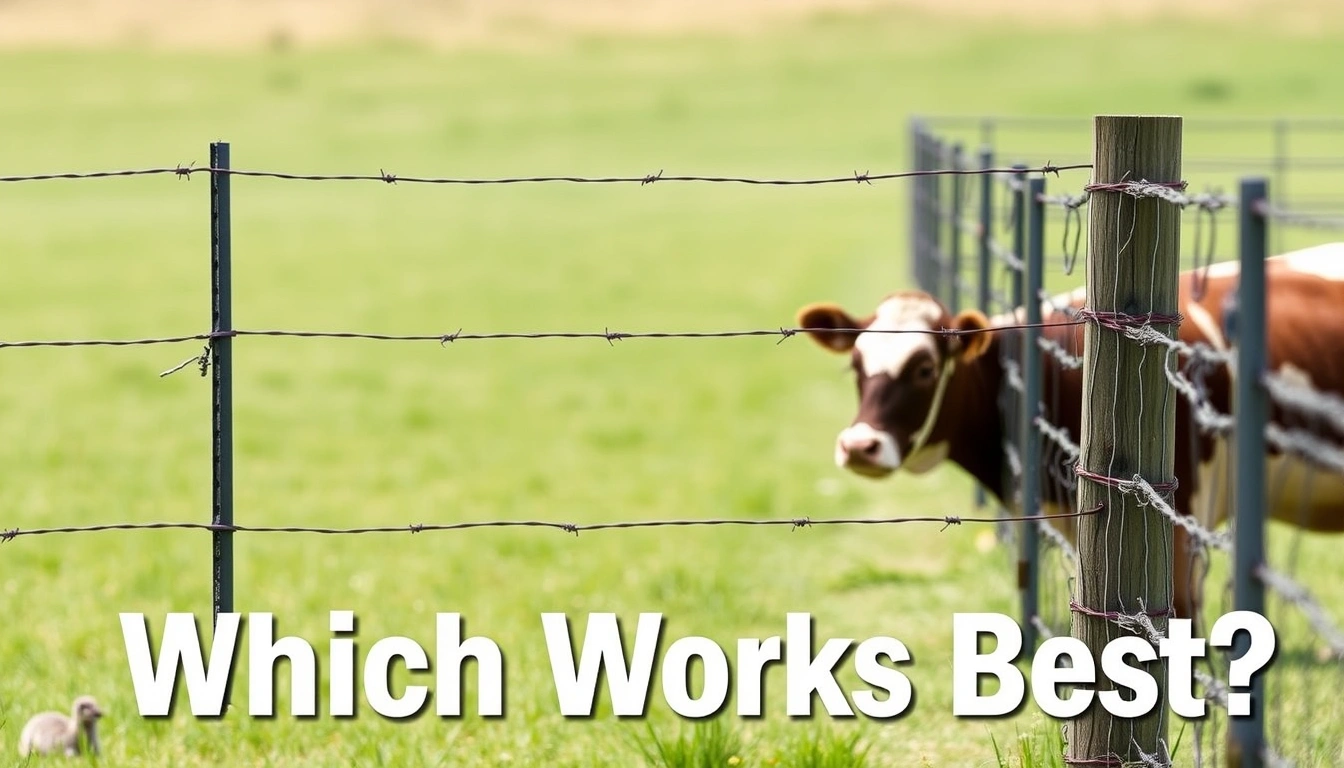
Barbed wire wins when you need to fence distance, not just a boundary point. It is the classic choice for large pastures, rotational grazing perimeters, and rough country where post spacing and line tension matter more than close-contact safety.
Its strength is economy of coverage. You can run several strands across a large property with fewer materials than a panel fence would require. It also handles uneven terrain better when installed correctly, because each strand can follow the ground’s changes without needing a rigid sheet. The National Agricultural Statistics Service continues to list barbed wire as one of the most common fence materials on U.S. farms.
But here is the catch: barbed wire is a psychological barrier first and a physical barrier second. Mature cattle often respect it. Youngstock, horned animals, wet-weather runners, and anything frightened by predators, dogs, or machinery may not. That gap is where trouble sneaks in.
Barbed wire is also the wrong answer where people will brush against the fence. Yards, barn lanes, trails, and the edge of a garden all raise the odds that a sleeve, flank, or dog can catch a barb. Need a fence that tolerates daily human contact? Barbed wire is the riskier choice.
Upkeep can hide in plain sight. A strand that sags, breaks, or loses tension weakens the whole line. Because the system depends on wire stretch and post integrity, one problem often spreads into several. Low-maintenance, until it isn’t.
I would choose barbed wire if the main job is enclosing acreage for adult cattle and the fence line is far enough from traffic, people, and sensitive animals that the sharp edges do not create a daily hazard.
The honest side-by-side
Cattle panel and barbed wire are built for different kinds of containment, and the right one changes with the job. Here is the clearest comparison.
| Criteria | Cattle Panel | Barbed Wire | Winner for [condition] |
|---|---|---|---|
| Physical stopping power | Rigid welded barrier | Multiple tensioned strands | Cattle panel for pushy animals |
| Long perimeter cost efficiency | Material-heavy | Material-light | Barbed wire for acreage |
| Safety for people and close handling | Fewer sharp contact points | Barbs create snag risk | Cattle panel near traffic |
| Ease of spanning uneven ground | Short rigid sections | Flexible line | Barbed wire on rough terrain |
| Risk of calves slipping through | Low, depending on opening size | Higher if spacing is loose | Cattle panel for youngstock |
| Behavior under pressure from rubbing or leaning | Holds shape if posts are solid | Can sag or break under load | Cattle panel for crowding zones |
| Speed of installation on long runs | Slower and heavier | Faster over distance | Barbed wire for field edges |
| Maintenance after a hit or break | Panel damage is localized but obvious | One failed strand can compromise tension | Cattle panel for visible faults |
| Suitability near dogs, kids, or horses | Better due to fewer point hazards | Poorer due to barbs | Cattle panel near mixed use |
That table is the short answer. The longer answer: cattle panel is a containment tool, while barbed wire is a perimeter tool. If your fence has to do both jobs, the safer method usually belongs where the risk is highest.
Which one works best for cattle containment?
Cattle panel works best for containment when the animal is likely to test the fence, when the fence is short, or when failure would be costly. That is the plain verdict.
For a calving pen, small paddock, handling lane, or the first line around a barnyard, I’d choose cattle panel because it gives you a stronger physical stop and fewer sharp contact hazards. It is easier to trust when animals get crowded or stressed.
Barbed wire works best when the cattle are mature, accustomed to fence lines, and spread across larger pasture boundaries. It is not the stronger barrier, but it is often the more practical one across distance. In ranch settings, that practicality matters. So does the budget.
The real mistake is choosing barbed wire for a spot where you actually need barrier-level containment. A lot of “fence problems” are really “wrong fence for the job” problems. If you have calves, horns, curious dogs, or frequent human traffic, I would not pick barbed wire just because it is the traditional cattle fence.
There is a middle-ground truth here that a generic article often skips: many properties benefit from both. A panel section at gates, corners, pens, and working areas can protect the places where pressure is highest, while barbed wire handles the long outer run. That hybrid approach is common for a reason. It assigns each material to the job it does best.
If I had to pick one overall for containment quality alone, I’d pick cattle panel.
When to reconsider this choice entirely
Sometimes the right answer is neither. I would step away from both options if any of these describe your site.
First, if you need a horse fence, barbed wire is usually the wrong starting point, and cattle panel can still be unsafe if the openings or edge finishes are not designed for equine behavior. Horses are a different risk class.
Second, if your main goal is predator exclusion, neither cattle panel nor barbed wire is ideal as a stand-alone answer. Ground gaps, climb pressure, and jump pressure change the design problem. You may need woven wire, electric offset, or a layered system.
Third, if you are fencing a high-traffic residential boundary, barbed wire is too hazardous and cattle panel may be too industrial-looking or too rigid for the space. Privacy, aesthetics, and local code can matter as much as livestock restraint.
Fourth, if you cannot set posts well, neither fence will forgive poor foundations. A 16-foot panel without proper support becomes a problem fast, and barbed wire without tension and brace work sags into a headache. The fence is only as good as the structure holding it.
My verdict
Choose cattle panel if you need the safer, stronger physical barrier for short runs, pens, gates, calving areas, or mixed-use spaces with people and animals close together. Choose barbed wire if you are fencing long acreage for mature cattle and need to cover distance with less material and weight. Neither if the fence must protect horses, children in daily contact, or predator-sensitive livestock without a more specialized design.
Exception scenarios that flip the verdict
Cattle panel usually wins, but these cases can flip the call.
-
You are fencing several hundred feet or more across rough pasture. Barbed wire becomes the practical choice because a full panel build is heavy and expensive in labor, even before you add braces and posts.
-
You have large, calm adult cattle and the fence line is remote. In that setting, barbed wire can be enough, especially if the animals already respect existing lines.
-
You need to move panels often. Barbed wire wins on permanent perimeter use; panel fencing is not friendly to frequent layout changes.
-
You are using the fence as a visual boundary more than a hard stop. Barbed wire is cheaper to run, though I would still avoid it near kids, dogs, or any place people pass close by.
What I would buy if this were my fence decision
I would buy cattle panel for any enclosure where failure would mean a loose animal in a yard, lane, or garden. I would buy barbed wire only where the fence is long, the cattle are mature, and the risk of human contact is low.
That is the whole decision in one sentence: cattle panel is the better containment fence, barbed wire is the better acreage fence.
If you are trying to solve both at once, do not force one material to do a job it was not built for. Use cattle panel where control matters, and barbed wire where scale matters.
FAQ
Is cattle panel better than barbed wire for calves?
Yes. Cattle panel is better for calves because it blocks small bodies from slipping through openings that might be acceptable for mature cattle.
Is barbed wire enough for cows?
Sometimes. Barbed wire can work for adult cattle in large pasture systems, but it is weaker for pushy animals, crowded areas, and anywhere people or dogs are close to the fence.
Can I mix cattle panel and barbed wire?
Yes. A common layout is cattle panel at gates, corners, pens, and handling areas, with barbed wire on longer perimeter runs.
Which fence is safer around people?
Cattle panel is safer around people because it does not present barbs at arm, leg, and face height the way barbed wire does.
Which one lasts longer?
Either can last a long time if installed correctly, but lifespan depends more on posts, tension, corrosion resistance, and maintenance than on the material alone.